1X2 betting with multi-outcome Kelly
examples/multi_outcome_1x2.py bets the three legs of one mutually
exclusive football market — a 1X2 book — with the same fixed prices every
match: a home win at probability 0.42 and decimal odds 3.2 (edge +0.344),
a draw at probability 0.27 and odds 3.4 (edge −0.082), and an away win at
probability 0.28 and odds 2.4 (edge −0.328). The quoted probabilities sum
to 0.97, so the remaining 3% of the mass is a void round: no leg settles
and every stake is refunded.
Three strategies are compared over 30 seeded simulations of 250 matches each, from a $1,000 bankroll:
Multi-outcome Kelly — the log-growth-optimal stake per leg. It backs the home leg most, hedges a little on the draw’s rich odds, and declines the negative-edge away leg entirely.
Flat 5% (all legs) — stakes 5% of the bankroll on every leg. Two of the three legs are negative-edge, so most of this stake works against the bettor; the home edge still carries the portfolio.
Favorite-only 10% — stakes 10% on the most probable leg only. Positive expectation, but a cruder allocation than Kelly’s.
The script also demonstrates the reproducibility contract as public behaviour: the same seeded simulator run twice replays the identical bankroll history, and the script asserts it.
Warning
These are simulated results from a model, not a forecast and not betting advice. The market is a made-up book with fixed prices and probabilities you cannot get from a real bookmaker, and the void-round convention is the simulator’s, not a settlement rule any exchange offers. Keeks is an educational library; treat every number below as a property of the model, not a prediction about money.
What the spread says
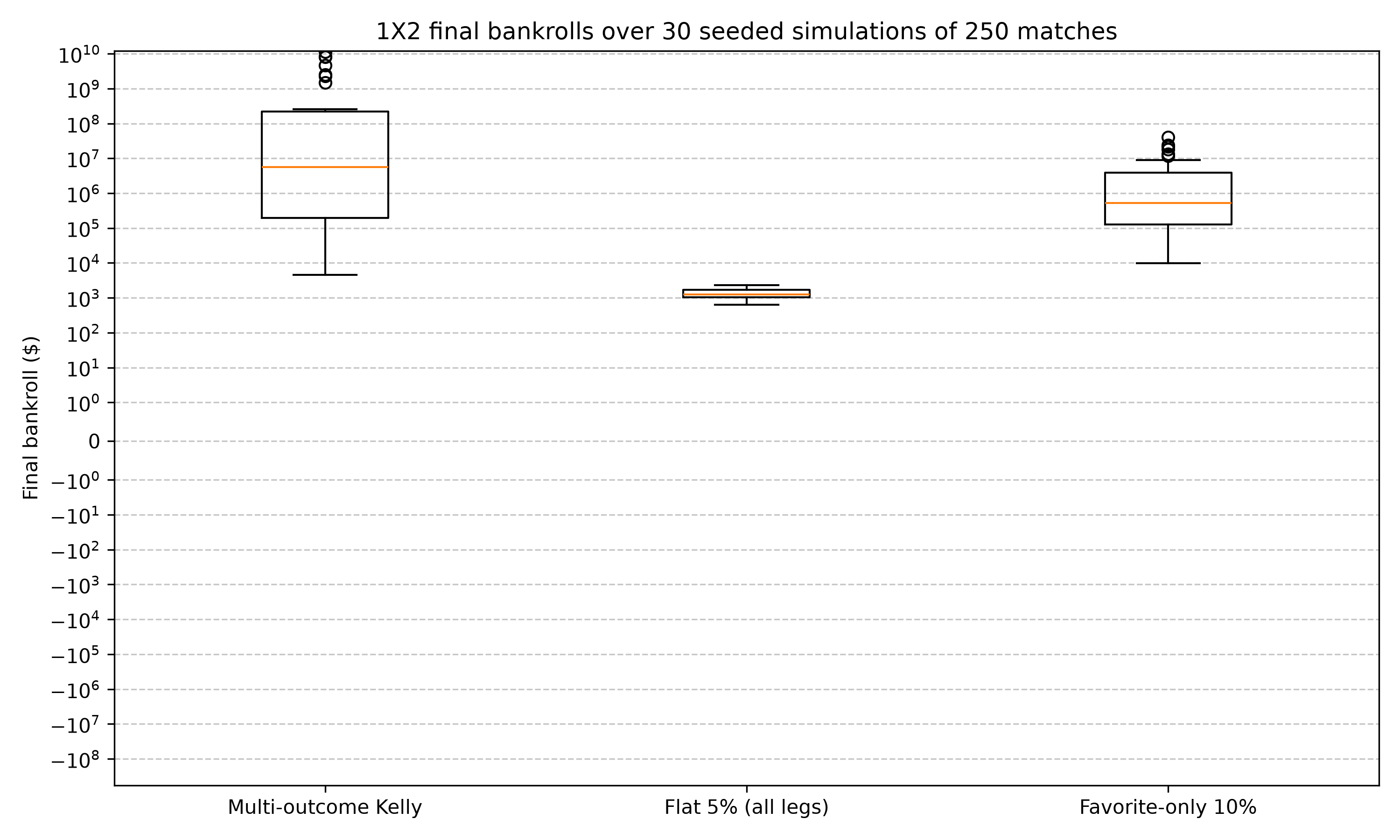
Final bankrolls over 30 seeded simulations of 250 matches. The vertical axis is symmetric-log because Kelly’s compounding spans many orders of magnitude.
The log-optimal split is worth orders of magnitude more than flat staking here, and the boxplot makes the mechanism visible rather than just the outcome. Kelly’s opening stake vector puts most of the stake on the one leg with a positive edge, takes a small hedge on the draw, and refuses the away leg outright — so its bankroll compounds on the home edge alone. Flat 5% spreads two thirds of its exposure onto negative-edge legs and ends near where it started. Favorite-only 10% sits between: it never bets a negative-edge leg, but it over-concentrates in a single outcome, which widens the box.
Reproducing it
One command, from a checkout of the repository:
uv run python examples/multi_outcome_1x2.py
It prints Kelly’s opening stake vector, the seeded-replay check, and a
final-bankroll distribution table (mean, median, min, max per strategy
with void-round and early-stop counts), then writes the chart and
examples/output/multi_outcome_1x2.csv.